
Good Code Builds Software. Business Understanding Builds Solutions
November 27, 2026 · 8 min read · Desha Das
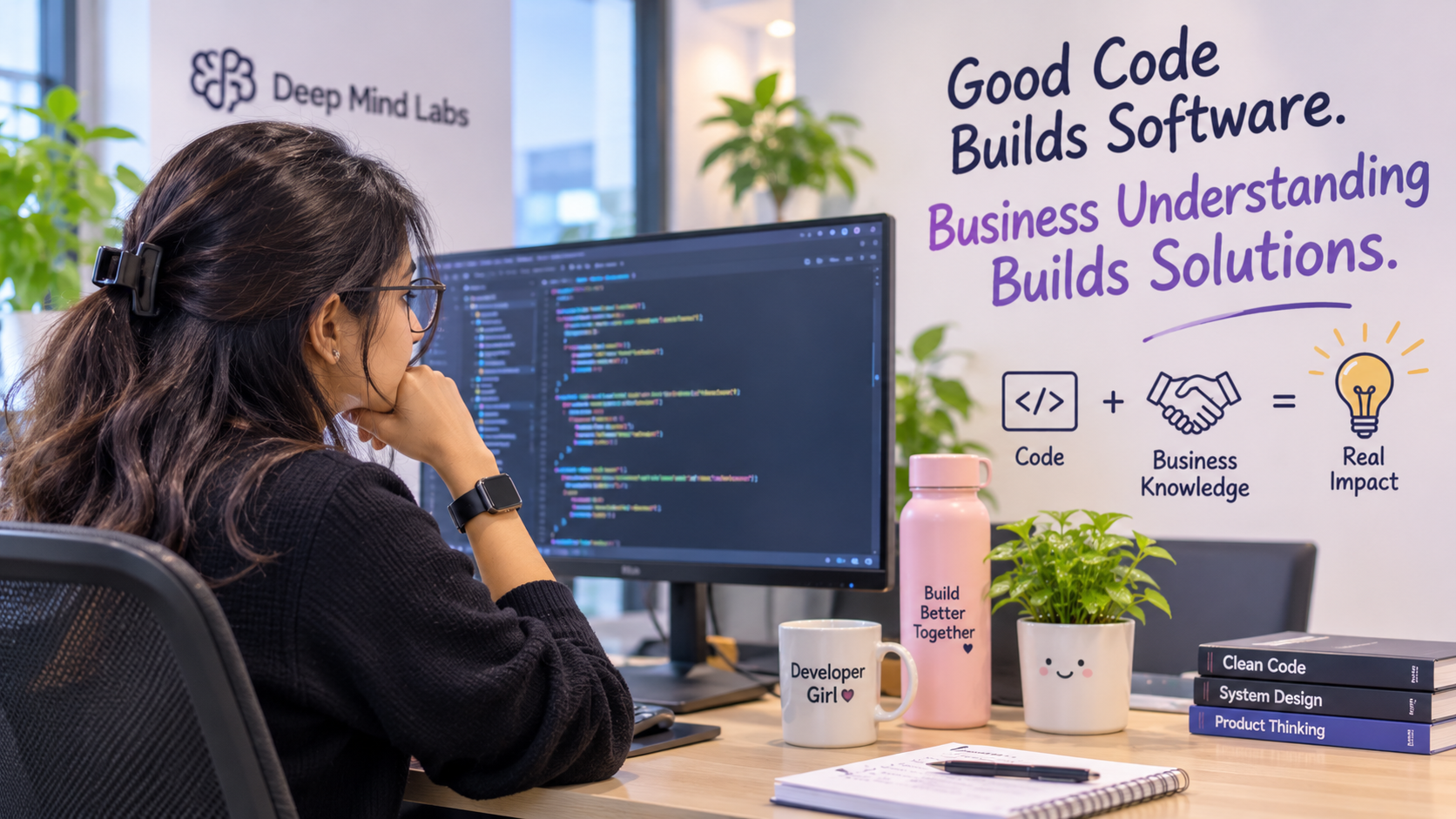
It's More Than Just Writing Code
As software developers, we spend much of our time writing code, building user interfaces, integrating APIs, managing application state, fixing bugs, and implementing new features. We continuously learn new frameworks, explore libraries, and look for better ways to write clean, efficient, and maintainable code.
But have we ever stopped to think about something beyond the code?
Imagine you're assigned a task to build a feature. You understand the requirements, design the UI, connect the API, handle the responses, and everything works as expected. From a technical perspective, the task is complete.
But what if the feature doesn't actually solve the problem the user is facing?
What if the implementation works perfectly but doesn't follow the actual business process?
This is where an important aspect of software development comes into play: understanding business logic.
Software development isn't just about making things work technically. It's about understanding what needs to work, why it needs to work, and how it should behave in real-world situations.
Good code is essential, but without understanding the problem behind it, even the cleanest implementation can produce the wrong solution.
What Does Business Understanding Actually Mean?
Business understanding doesn't mean that every developer needs to become a business analyst, accountant, or industry expert.
It simply means understanding the purpose, rules, processes, and real-world problems that the software is designed to address.
Every application exists for a reason. An e-commerce platform helps businesses sell products. A banking application manages financial transactions. A healthcare system supports patient care. A manufacturing system helps manage production and resources.
Each of these applications follows a set of business rules.
For example, consider a simple online shopping application.
A customer selects a product, adds it to the cart, and proceeds to checkout. From a technical perspective, this might involve managing state, validating forms, and integrating payment APIs.
But the actual business process involves much more:
Is the product available in sufficient quantity?
Is the customer eligible for a discount?
Has the payment been successfully completed?
When should the inventory be updated?
What happens if the payment succeeds but order creation fails?
Can the customer cancel the order after it has been shipped?
These questions represent business logic.
Understanding them helps developers build applications that behave correctly, not just applications that look and function well on the surface.
Beyond UI and API Integration
For frontend developers, it's easy to become focused on what happens inside the browser.
We think about components, props, hooks, state management, routing, API calls, loading states, and error handling. These are important parts of frontend development.
However, the frontend is only one part of a larger system.
Let's consider an employee leave management feature.
An employee opens the application, selects a leave type, chooses the dates, enters a reason, and submits the request.
The frontend developer might need to:
Build the leave request form.
Implement field validation.
Manage form state.
Integrate the submission API.
Display success and error messages.
But there's another layer of questions:
Does the employee have enough leave balance?
Are there restrictions on certain dates?
Does the request require one or multiple approvals?
Can an employee withdraw a pending request?
What happens when the request is rejected?
When should the leave balance actually be deducted?
If we only focus on the UI and API, we might successfully submit the request without fully understanding how the leave management process should work.
The difference is that technical implementation tells us how to build the feature, while business understanding tells us how the feature should behave.
A form can be technically perfect and still represent a broken business process.
Every Feature Has a Business Story Behind It
One thing worth remembering is that software features rarely exist independently. Most of them are connected to other activities, users, and processes.
Let's look at a few everyday examples.
E-commerce: More Than Placing an Order
When a customer places an order, the system needs to coordinate product availability, payment, inventory, delivery, and customer notifications.
A developer who understands this process can anticipate situations such as insufficient stock, failed payments, duplicate orders, and cancelled shipments.
Banking: More Than Transferring Money
A money transfer is not simply a form submission followed by an API response.
The system must verify account information, check available balances, apply transaction limits, validate permissions, and ensure that financial records remain consistent.
Healthcare: More Than Booking an Appointment
An appointment scheduling feature may need to consider doctor availability, patient records, appointment types, consultation duration, and scheduling conflicts.
Manufacturing: More Than Managing Products
Production involves raw materials, resource planning, labour, production capacity, quality checks, and finished goods.
These examples demonstrate that the real complexity of software often comes from the business processes behind the interface.
When developers understand these processes, they can make better decisions about how the application should work.
Why Business Understanding Makes a Difference
Understanding business logic can change the way we approach almost every development task.
Here are some important benefits.
Better Problem-Solving
Sometimes, users describe what they want rather than explaining the problem they're experiencing.
For example, a user might request an additional button to solve a particular workflow issue. But after understanding the process, you may discover that the real problem is related to permissions, validation, or an incomplete workflow.
Instead of simply implementing the requested change, you can help identify the actual problem.
Fewer Logical Errors
Not every bug is caused by incorrect code.
Sometimes, the code works exactly as written, but the implemented behavior doesn't match the expected business rules.
Imagine an application that allows users to approve their own purchase requests when company policy requires approval from a manager.
The application might have no technical errors, but the business logic is incorrect.
Understanding business rules helps developers identify these issues before they become serious problems.
Better User Experience
A good user experience is not only about attractive designs, smooth animations, or responsive layouts.
It's also about understanding what users are trying to accomplish.
When developers understand user workflows, they can reduce unnecessary steps, prevent invalid actions, provide meaningful feedback, and create more intuitive interactions.
Better Technical Decisions
Business requirements often influence how we structure and implement an application.
For example, understanding that a process requires multiple approval levels can influence how we approach permissions, workflow management, state transitions, and API interactions.
Without understanding the requirement, we might build something that works for the current screen but becomes difficult to maintain when the business process changes.
Better Collaboration
Software development is a collaborative process.
Developers regularly communicate with product managers, designers, QA engineers, business analysts, and other stakeholders.
Understanding business terminology and workflows makes these conversations more meaningful. It also helps us ask better questions, identify missing requirements, and explain technical decisions more effectively.
Think Beyond the Happy Path
One common mistake developers make, especially when implementing a new feature, is focusing mainly on the successful scenario.
We build the form, submit the data, receive a successful response, and move on.
But real-world applications rarely operate under perfect conditions.
Consider a payment process:
Happy path:
Customer places an order.
Payment is successful.
Order is confirmed.
Inventory is updated.
What if something goes wrong?
Payment fails.
The customer clicks the payment button multiple times.
Payment succeeds, but the application doesn't receive the confirmation.
Inventory becomes unavailable before checkout finishes.
The order is cancelled after payment.
Each situation requires specific business rules.
For example, a system must avoid charging customers twice for the same order. It must also ensure that payment and order statuses remain consistent.
Thinking about these scenarios is not just a testing responsibility. Developers should consider them during implementation as well.
Understanding business logic helps us recognize that the successful path is only one part of the complete workflow.
How Developers Can Develop Business Understanding
The good news is that understanding business logic doesn't require a completely different skill set. It starts with developing better habits.
Here are some practical approaches.
1. Ask Why Before Asking How
Before starting a task, understand why the feature is needed and what problem it is intended to solve.
2. Understand the Complete Workflow
Don't focus only on the screen you're working on. Try to understand what happens before and after a particular action.
3. Learn the Business Terminology
Every industry has its own language. Learn the basic concepts and terminology of the domain you're working in.
4. Ask Questions and Communicate
Talk with product managers, QA engineers, business analysts, and users. They often understand the real-world process better than technical documentation alone.
5. Explore Different Scenarios
Think about what happens when something fails, gets cancelled, requires approval, or changes unexpectedly.
6. Understand the Impact of Your Changes
A small change in one module can affect other parts of an application. Consider how your implementation influences related data, workflows, and users.
7. Learn from Testing
Testing is a great opportunity to understand business processes. Instead of checking only whether a button works, explore whether the entire workflow produces the expected outcome.
These habits gradually help developers move from task-oriented implementation toward problem-oriented development.
From a Developer Who Writes Code to a Developer Who Solves Problems
There is an important mindset shift that can make a difference in a developer's career.
Instead of thinking only about:
How should I build this component?
Which API should I integrate?
How should I manage this state?
How can I make this page more responsive?
Start thinking about:
What problem are we actually solving?
Who will use this feature?
Why does this process exist?
What rules should the application follow?
What happens if something goes wrong?
How does this feature affect other parts of the system?
This doesn't mean technical skills become less important. Quite the opposite.
The stronger your technical knowledge becomes, the more valuable it is when combined with a clear understanding of the problem you're solving.
A developer who understands both sides can contribute beyond implementation. They can identify gaps in requirements, suggest improvements, recognize potential issues, and help build solutions that support actual business needs.
That's an important step in growing from someone who simply completes development tasks into someone who contributes to building better products.
Conclusion: Build With Purpose, Not Just Code
Learning programming languages, frameworks, libraries, and development tools is essential for becoming a good software developer.
But technical knowledge alone doesn't tell us whether we're building the right solution.
Understanding business logic helps us connect our technical decisions with real-world needs. It allows us to see beyond individual components, API responses, and assigned tasks to understand the complete problem.
We don't need to become experts in every industry we work with. But we should always be curious about the domain, the people using our software, and the processes our applications are designed to support.
The next time you receive a development task, take a moment before opening your code editor.
Understand the requirement. Explore the workflow. Ask questions. Think about the possible outcomes.
Because ultimately:
Good code builds software. Business understanding builds solutions.
And the best developers know how to bring both together.

Comments
No comments yet. Start the conversation.