
Breaking the AI Gatekeepers: Why Bangladesh Needs a Sovereign Foundation Model
November 18, 2026 · 4 min read · Saiful Sohag
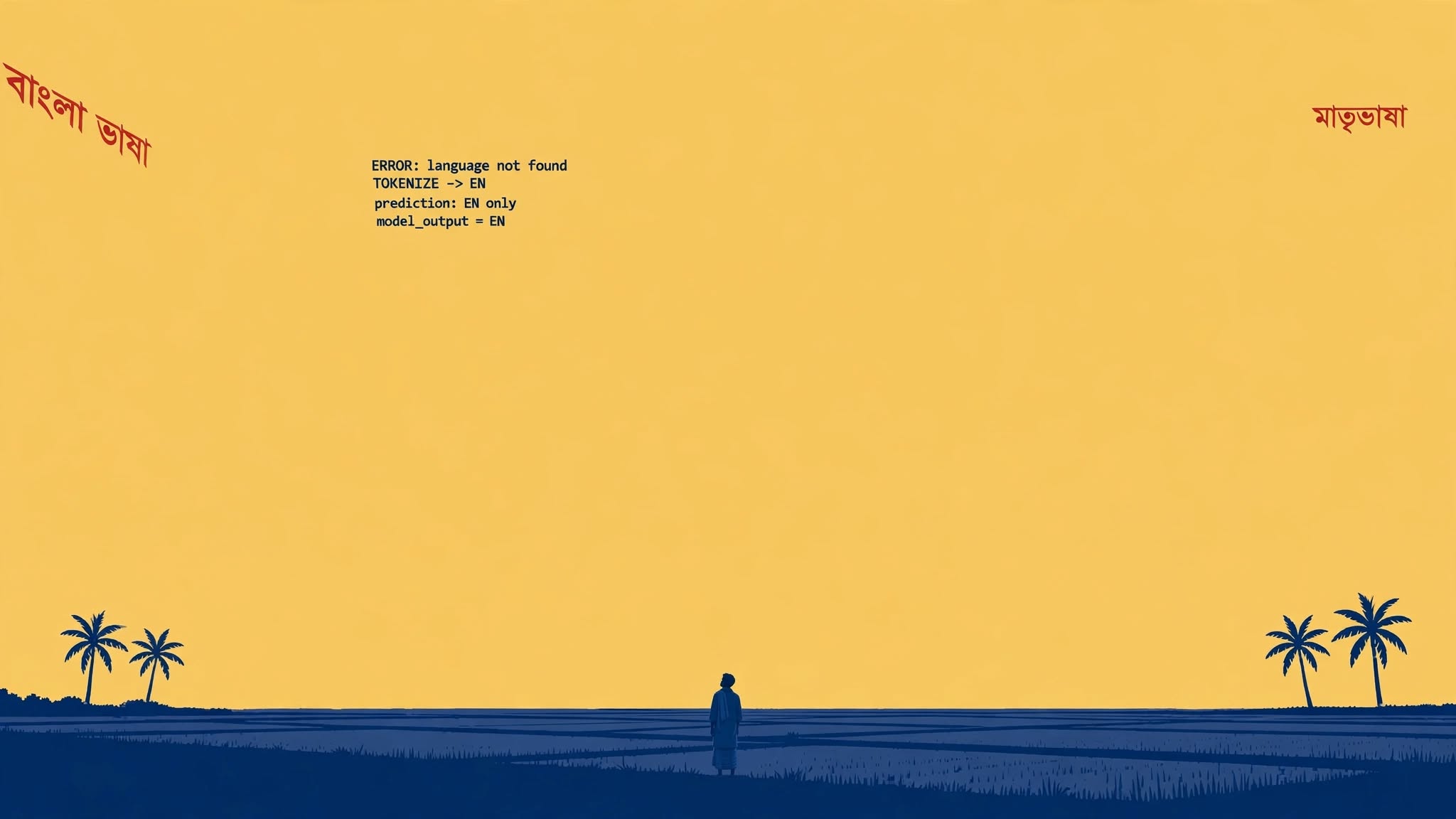
Most language-specific AI models, whether large language models (LLMs), text-to-speech models(TTS), or image generators, come with a language support index. They list their capabilities via ISO acronyms: en for English, fr for French, es for Spanish. For Bangladesh, that bn tag is almost always missing.
When Bangladeshi researchers attempt to build AI solutions for our citizens, whether an LLM powered tutor bot or a vision powered voice based digital health assistant, they immediately hit a brick wall built from a lack of data and compute. The crisis starts at the very gateway of language processing: the tokenizer, which fragments words into numerical tokens for the model to process.
The Digital Erasure of Bangla
In most modern LLMs, 95% of the vocabulary is reserved for English. The remaining 5% is split among every other language on Earth. Despite Bangla being the fifth most spoken language globally, it struggles to secure even a 0.5% footprint in mainstream models.
The real-world consequences are embarrassing. Supposedly "genius" global models confidently freeze when fed a local land deed, translating archaic, Farsi-influenced administrative terms like "Mouza" (মৌজা), "Khatian" (খতিয়ান), or "Daag Number" (দাগ নম্বর) into literal nonsense. This is not a trivial translation error, it is a symptom of structural erasure that prevents us from building basic, functional digital services for our citizens.
For Bangladeshi AI practitioners, checking Hugging Face, GitHub for ML engineers, has become a heartbreaking ritual. A groundbreaking new model drops, boasting robust "multilingual" support for dozens of languages, and Bangla is nowhere to be found. Look at Qwen-TTS, a recent state-of-the-art text-to-speech model pretrained on two million hours of audio across 20 languages. No bn.
On the rare occasion an Indian research lab pretrains an Indic model, Bengali gets included, but it is rarely our Bangla. It greets users with "Namaskar", uses "Jol" instead of "Pani," frequently and speaks with a heavy Hindi accent. It requires aggressive, metaphorically surgical fine-tuning just to be culturally acceptable in Bangladesh.
Even when a major model technically includes Bangla, such as Google’s open-source LLM Gemma 4 with its massive 250,000-token vocabulary, the tokenizer remains so inefficient for our script that generation becomes slow and expensive. Without proper native pretraining, downstream fine-tuning remains an uphill battle, if not impossible.
AI is the New Electricity
As computer scientist Andrew Ng famously said, "AI is the new electricity." We cannot sit idly by and wait for the global private sector to notice us. A capable, native foundation model is the goose that lays the golden eggs; it will power our digital economy and unlock entirely new local industries for years.
Right now, Bangladeshi developers are forced into clunky workarounds. Because there is no native Bangla CLIP or SigLIP model, we cannot generate images directly from Bangla prompts. We must translate our thoughts to English first, losing nuance in the process. While Google's Nano Banana 2 have attempted to bridge the gap, they remain primitive, frequently leaking Assamese characters into Bengali text.
We lack a high-quality, direct translation model like French to English. Fixing just this one translation bottleneck would breathe life into our entire tech ecosystem.
This is not a talent deficit. It is not a data-labeling. The global open-source community is the most egalitarian force we have seen since the dawn of the web. We do not need to reinvent the wheel from scratch.We just need enough compute.
Language as Sovereignty
There was once a legitimate fear that globalization would accelerate the death of low-resource languages by allowing English to swallow them whole. Luckily AI has flipped the script. It now possesses the power to preserve languages in their full, localized beauty. We can see this in speeches dubbed on Facebook and YouTube videos.
Meta has already proven this. Their multilingual Automatic Speech Recognition (ASR) models can transcribe over 1,600 languages, surprisingly including regional Bangladeshi dialects like Chittagonian, Sylheti, and Rangpuri. The open-source architecture is there, anyone can fine-tune these models, even on modest compute setups.
Language is the bedrock of sovereignty. World leaders use interpreters even when they are perfectly fluent in English. If we want to preserve our culture, history, and social fabric, we must own our infrastructure. Otherwise, we risk sliding into a unipolar digital society where 170 million people are forced to think, write, and conceptualize the world through the sterilized lens of a Western ChatGPT.
Bangladesh does not have a Google or a Meta. But we have a state. Since pretraining from scratch is too expensive for local startups or universities, the government must step in to fund and release some open-source Bangla Foundation Model. Let our developer community handle the fine-tuning for specific applications. That initial state investment will pay dividends for generations.
What We Could Build Tomorrow
With a robust, state-backed Bangla foundation model, the immediate returns would transform the nation. A localized Bangla LLM could serve as a patient, tireless 24/7 tutor for around 20 million students efficiently.
An accent-aware transcription model could document a patient’s history in a rural village clinic, summarize it, and hand it to an overworked doctor, saving critical time and lives in a country facing a severe physician shortage.
Expressive text-to-speech models could instantly read emergency alerts, weather warnings, and government policies aloud to millions of citizens who cannot read.
Computer vision problems like lane detection, traffic violations, and license plate recognition are technically solved. In job interviews, we reject resumes that brag about these projects because they are so basic. Yet, at our toll plazas, we still endure massive traffic jams just to manually collect cash. A Jetson Nano and a camera could automate this tomorrow, saving billions.
The barrier holding Bangladesh back from the AI revolution is no longer technical. It is political. It is time to fund our digital future.

Comments
No comments yet. Start the conversation.